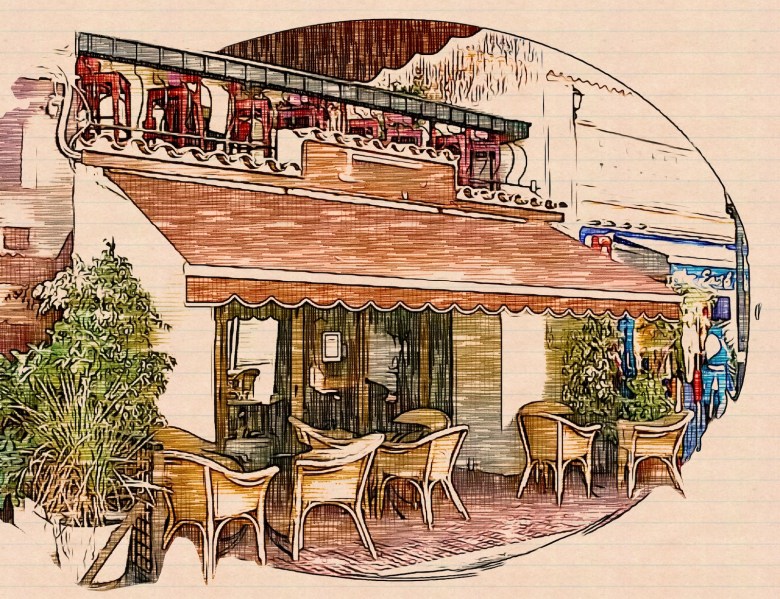
Echoes from El Caballo Negro

The Voice That Bridged Time

The morning light at Whispering Pines Cottage filtered through the diamond-faceted windows. It cast geometric patterns across the rough-tiled floor. These patterns were like ones Madam Setsuna had seen decades earlier. She had forgotten the name of the place until today. Strela maintained her vigilant position by the glass door. Her white fur was luminous in the morning glow. Meanwhile, Madam Setsuna performed her ritual with the Bialetti coffee maker.

Steam rose in delicate spirals as the familiar gurgling sound announced coffee’s readiness. The BBC Radio 4 documentary played in the background—”The White Island: Ibiza’s Hidden History.” It was pleasant but unremarkable. A particular voice emerged from the speakers. It caused Madam Setsuna’s hand to halt mid-pour, with coffee suspended in a perfect arc between pot and cup.

“People misunderstand what made Sandy’s Bar special,” the voice said, its Irish lilt mellowed by decades in the Mediterranean sun. “It was not about mix what some discerning folks would call a perfect Bloody Mary. It wasn’t the location—a converted hen-house on an unpaved street, for heaven’s sake. It was the collision of worlds that happened there. From midday onwards, a delightful medley of characters would gather. Amiable old expatriates shared tales of distant homes. Visiting actors and artists sketched or recited impromptu verses. Colorful Ibizans told stories stretching back generations. An assortment of eccentric locals joined in. Their peculiarities were accepted as natural embellishments to the island’s tapestry. Tourists finding conversations they’d remember long after they’d forgotten the beaches.”

The voice continued, resonant and reflective. “That’s why El Caballo Negro became what it was—a crossroads where lives intersected. Sometimes it was just for an evening, and sometimes it was for decades. Artists, musicians, locals, tourists, and yes, even the occasional spiritual seeker. Everyone was welcome, provided they brought good conversation.”

The coffee trickled over the rim of the cup, pooling on the countertop, but Madam Setsuna didn’t notice. Her attention was wholly captured by this unexpected intrusion from the past. It was a voice that had been filed away in her memory so completely. She hadn’t known it was there until this moment.

“That was Sandy Pratt,” the interviewer concluded, “legendary proprietor of Sandy’s Bar—otherwise known as El Caballo Negro. It was located in a former hen-house on an unpaved street in the fishing village of Santa Eulalia. The location became a gathering place for the island’s creative community. This occurred from the 1960s through the 1990s. Notable residents often visited the bar. These included Joni Mitchell, Nico from the Velvet Underground, and actor Terry Thomas. Terry Thomas, as Sandy just told us, drove a car painted with flowers to match one of his shirts.”

Strela, with the intuition that made her such a perfect companion, sensed the shift in her human’s demeanor. She padded across the room. She tilted her head inquiringly. Her glasses caught the morning light in a flash. It seemed to punctuate the moment’s significance.

“Strela,” Madam Setsuna whispered, her voice carrying the tremor of one who has seen a ghost, “I know that voice. I’ve heard it before… but I never knew his name until this moment.”

She abandoned the spilled coffee and moved to her armchair. She sank into it as memories long submerged rose to the surface. They emerged like air bubbles from the depths of a forgotten sea.

“It was September 1993,” she began, her gaze fixed on something Strela couldn’t see. “I was twenty-plus, just beginning to find my footing in system analysys after completing my mathematics degree. I had received my first proper paycheck—a sum that seems laughably small now but felt like a fortune then.”

Her lips curved into a smile at the memory of her younger self’s impulsivity. “I could have paid off student loans. I could have invested in professional attire as any sensible young woman would have done. Instead, I walked into a travel agency on a whim. I booked a week on an island I knew nothing about, beyond its reputation for hedonism. ‘Tour for Ibiza,’ I said. ‘As soon as possible.’ The agent looked at me as if I’d sprouted a second head. I was a solitary young woman with serious glasses and sensible shoes. I was bound for the party capital of Europe.”

Strela settled at her feet. Her posture communicated that she understood the gravity of what was unfolding. This wasn’t merely reminiscence. It was revelation.

The Black Horse’s Haven

“Ibiza in 1993 was at a fascinating crossroads.” Madam Setsuna continued. Her voice took on the measured cadence she used when piecing together a complex puzzle. “The massive commercialization of its club scene hadn’t yet reached its peak. There was still something raw and authentic beneath the emerging gloss. Some pockets of the island remained true to the bohemian spirit. This spirit had drawn artists and free-thinkers there since the 1960s.”

The young Setsuna of those days hadn’t planned to discover any of this authenticity. Her ferry had taken her to Ibiza Town. She dutifully explored the beaches. She also visited the nightclubs that tourists were expected to visit. She had danced at Pacha and Amnesia. She watched the sunset at Café del Mar. She wandered the fortified old town with its winding cobblestone streets.

“I met a group of Germans at a beach party. They convinced me to venture beyond the typical tourist circuit,” she recalled. “They spoke of Sta Eulalia with a reverence that piqued my curiosity. They described it as ‘the real Ibiza,’ whatever that meant to them. I allowed myself to be persuaded. I did not realize this casual decision would alter the trajectory of my life in unforeseen ways.”

Only on my final day did I realize the complication this side trip had created. I was standing at the bus station in Santa Eulalia. I discovered that returning to Ibiza Town and the ferry port would be far more difficult than anticipated.

“I need to reach the Port of Ibiza today,” she had explained to the clerk. He was a young man with black, slightly curly hair. He seemed perpetually amused by the predicaments of tourists.

“Not possible today, señorita,” he had replied. He shrugged with the practiced indifference of one who had delivered this news countless times. “There’s a festival and all our vehicles are committed there. Tomorrow morning is the soonest.”

His casual dismissal of her carefully planned itinerary had filled the young Setsuna with a mixture of anxiety. She also felt indignation that seemed, in retrospect, laughably disproportionate. Missing her ferry led to rearranging her flight. She had to explain her absence to her new employers. Most distressingly to her methodical mind, it meant deviating from a schedule.

She was stranded with hours to wait and no solution in sight. She had wandered the quiet streets of Santa Eulalia. It was a town that existed defiantly. It went against the pulsing energy defining the island’s more famous destinations. Here, elderly men played backgammon in the shade of orange trees. Fishermen mended nets by the harbor. Life moved at the unhurried pace of a place that had nothing to prove.

As afternoon shadows lengthened, her frustration gradually gave way to resignation. She found herself on a narrow, unpaved street. She stood facing an establishment whose weathered sign read “El Caballo Negro”—The Black Horse.
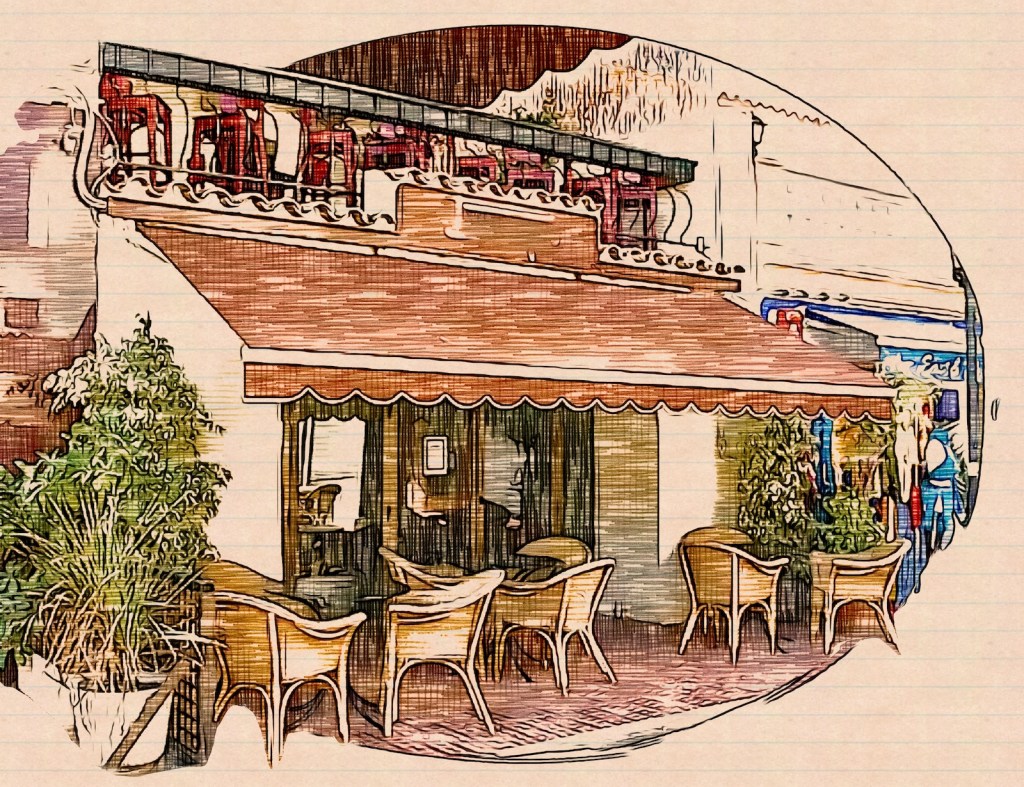
“There was nothing remarkable about its exterior,” Madam Setsuna told Strela. “Nothing that would suggest its significance—either to the island’s cultural history or to my personal future. Just another whitewashed building with a wooden door and shuttered windows. But something drew me in—perhaps simply the promise of shade and something cold to drink while I contemplated my predicament.”

The transition from the harsh Mediterranean sun to the bar’s cool interior temporarily blinded her. As her eyes adjusted, the first thing she noticed was the quality of light. It filtered through small diamond-shaped panes in the windows. These patterns across the rough-tiled floor seemed almost deliberately placed. It was as if the sun itself were an accomplice in the bar’s mysterious atmosphere.

“I remember the sensation of crossing a threshold that was more than merely physical,” she said. “It was as though I’d stepped from one realm of existence into another. I moved from the predictable world of schedules and expectations into a space where different rules applied. I couldn’t have articulated what those rules might be.”

She approached the bar. She ordered coffee from the man she now knew to be Sandy. He was a tall, fair-haired, fine-featured Irishman. His quiet demeanor belied a sharp observational intelligence. He nodded at her ask. He did not comment. He turned to prepare the coffee with the unhurried precision. He was like one who believes that anything worth doing is worth doing properly.

The young madam Setsuna found a small table in the corner. It gave her an excellent vantage point to watch the room. Even then, her cryptographer’s mind was constantly collecting and cataloging details, searching for patterns in the seemingly random.

The décor of El Caballo Negro was an education in itself—a physical chronicle of decades of island life. Paintings of varying quality hung alongside black-and-white photographs of faces both famous and unknown. Shelf-lined walls heaved with books in multiple languages, their spines faded by sun and handling. Every available surface was occupied by objects. These objects were classified as either art or artifacts, depending on one’s perspective. The collection included driftwood sculptures, antique nautical instruments, and ceramics. These ceramics had the unmistakable organic quality of local craftsmanship.

“It hadn’t been designed as a space,” Madam Setsuna explained to Strela. “Instead, it had evolved. Each object earned its place through some significance known perhaps only to Sandy himself. The result was an environment that felt random. It also felt perfectly calibrated, like walking into the physical manifestation of someone’s memory palace.”
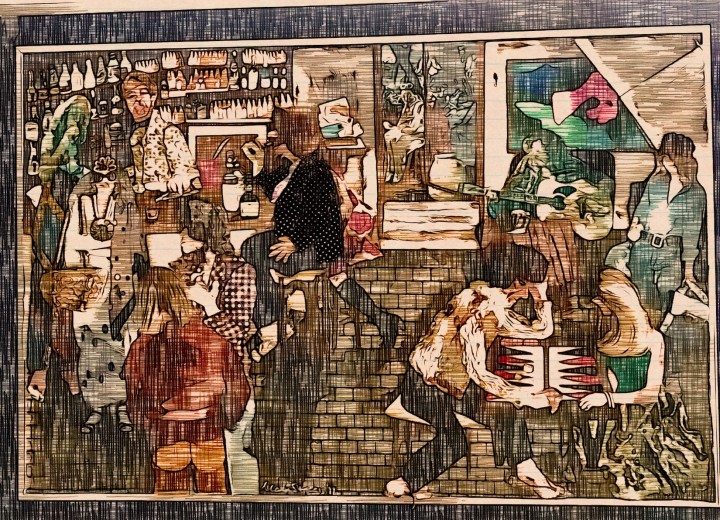
The patrons were as diverse as the décor. Several obvious tourists leafed through guidebooks. They looked somewhat bewildered at having stumbled upon a place so distinctly not marketed to them. Near the window, two men with the unmistakable look of artists debated some point of an art object. They discussed this with passionate intensity. For them, art is not abstract concepts. It is matters of life and death. A beat-up guitar accompanied them by improvised percussion. A song might start as a whisper and swell into a small, holy event.

Ah, yes—backgammon. At El Caballo Negro, the game wasn’t just a pastime. It was a quiet ritual. It was performed mostly by the elder locals—men with sun-browned hands and deeply lined faces. Their expressions rarely changed whether they won or lost. Their weathered hands moved with the fluid certainty that comes from decades of the same motions. Madam Setsuna always watched. She might have noted:
• The rules were never taught. People assumed you were either born knowing them. Or you were not meant to learn.
• Moves were made without hesitation, but not hurried. As if memory and instinct played the game, not thought.
• Bets were never spoken aloud. They were settled in gestures—a nod, a shrug, a half-smile with eyes still on the board.
• Conversations unfolded between the rolls: murmured gossip, political jabs, nostalgic sighs. Occasionally, a bit of singing, usually off-key.
• One man always chewed on a matchstick. Another never wore shoes. A third had a notebook he never wrote in.

It wasn’t just backgammon—it was a kind of ritual grounding. It was a sign. While the world outside spun wildly with tourists, dancers, seekers, and noise, this corner of the bar remained constant. Like the stones of Santa Eulalia’s harbor wall.

But it was the gathering at the bar that gradually commanded the young Setsuna’s attention. Four or five people were gathered around a man who seemed to be forty-five or fifty. His physical presence was overshadowed by the focused intensity he projected. He spoke with measured authority about concepts. These concepts seemed to bridge science and metaphysics. His hands occasionally sketched geometric patterns in the air to illustrate particularly complex points.

“I hadn’t meant to eavesdrop,” Madam Setsuna admitted. “His voice carried clearly across the room. Once I began listening, I found I couldn’t stop. He discussed a system blending astronomy, quantum physics, genetics, and ancient religios traditions. He explained how understanding one’s genetic design could help individuals better use their energy. This understanding aids in making decisions and engaging with the world in a fulfilling way.”

Her attention was captured not by the content itself. Her scientifically trained mind would normally have dismissed it as pseudoscience. But, it was the mathematical precision with which he articulated these concepts that intrigued her. He spoke clearly. He discussed “gates” and “channels.” He mentioned “defined and undefined centers.” He addressed “strategy and authority” with the clarity of a mathematician explaining a complex theorem.

“It wasn’t his appearance that caught my attention,” Madam Setsuna recalled. “It was the structure of his language. Having just completed my mathematics degree, I was attuned to patterns, to the architectural blueprint beneath complex information. This man spoke about esoteric concepts with the rigor of a scientist presenting empirical findings.”

The young madam Setsuna had found herself leaning ahead slightly. She strained to catch every word as he explained. Her reaction was without consciously deciding to. He detailed how each person’s birth data—exact time, date, and location—could be used to calculate a “body graph.” This graph revealed their authentic nature and optimal decision-making strategy.

“He said that most people live their lives following mental strategies. They analyze, calculate, and weigh pros and cons. Many aren’t designed to make decisions that way at all,” Madam Setsuna told Strela. “Some, he said, are designed to respond to their environment. Others wait for recognition. Still others feel the truth in their physical bodies.”

As she listened, something resonated deep within her. It was not intellectual agreement but a visceral recognition. This recognition made the fine hairs on her arms stand on end. She had no context for what she was hearing, no framework to evaluate its validity or significance. Yet something about it broke through her habitual skepticism and touched a deeper knowing she hadn’t realized she possessed.
“I remained there for several hours,” Madam Setsuna said, “far longer than I’d intended. At some point, a local fisherman at a nearby table overheard my predicament about the ferry. He offered me a ride to the port in his boat—for a fee, of course, but reasonable enough. I accepted, made my ferry, and returned to home and my budding career.”

She paused, her fingers tracing the rim of her now-cold coffee cup. “And I forgot about that afternoon in El Caballo Negro. Or so I believed.”

The Metamorphosis Beneath Awareness

“I didn’t understand something then.” Madam Setsuna continued, her voice softer now, reflective. “Something fundamental had shifted inside me. This shift occurred during those few hours. The seeds of change had been planted, though they would take years to fully germinate.”

“Dear Strela, I just realized something important. The words I had heard that afternoon left me questioning ideas. These were ideas I had earlier taken for granted. Was the universe truly as separated as my scientific training had led me to believe? Or were there intricate connections between individuals and the cosmos that science was only beginning to glimpse? These questions challenged the foundation of my rationalist worldview, making me reconsider the nature of consciousness and decision-making. What is real mechanistic of Universe? “

“Most profoundly,” she told Strela, “it introduced the notion that our existence transcends the boundaries we perceive. We are not isolated individuals moving through space and time. Instead, we are interconnected aspects of a larger cosmic design. We constantly evolve through our interactions.”

After my Ibiza trip, “I began to see patterns where others saw only random behavior,” she explained. “I noticed I could feel how different person would do, often with an accuracy that startled my colleagues. When they asked how I knew, I couldn’t articulate it. Chaos appeared an order that needs to be deciphered. I simply perceived the underlying design”

“It was as though the information entered my mind and went underground,” Madam Setsuna mused, her eyes distant with wonder. “It worked quietly for decades. It reshaped my understanding without my awareness. Insights emerged, and I couldn’t explain their origins.”

Over the years, certain concepts had surfaced in my life. If I had recalled the conversation at El Caballo Negro, I might have recognized them. They were echoes of the framework I had heard described. These included the importance of understanding one’s natural decision-making strategy. There was also the recognition of different types of awareness. Additionally, aligning actions with authentic nature rather than conditioning of my mind was valued.

The Mystery Reveals Itself

“And now, hearing Sandy Pratt’s voice on the radio,” Madam Setsuna said. She finally reached for her cold coffee. “It’s as though a missing puzzle piece has clicked into place after decades of absence. A mystery I didn’t even know existed has begun to reveal itself.”

She rose from her chair, energized by the revelation. “I need to understand this fully,” she explained to Strela, who followed with alert interest. “Who was that man at the bar? What is this system he spoke of? And most importantly, how did a chance meeting with these ideas alter the course of my life? How could this have happened without my knowledge?”

The questions multiplied in her mind. Each one branched into others, like the fractal patterns she had spent her career studying. Had others been influenced by similar chance encounters? Was the bar deliberately positioned as a nexus point for the exchange of such ideas? Who else had been present that day whose significance she had missed entirely?

“To think,” Madam Setsuna said to Strela. Her voice was tinged with awe. “All these years, I’ve been carrying the influence of those few hours, never knowing its source. How many other moments like this shape us without our awareness? How many chance encounters plant seeds that grow into the forests of our lives?”

She moved to the window. She gazed out at the pines that surrounded their cottage. These were trees she had chosen to live among. She did not fully understand why their whispered conversations in the wind always seemed like a language. It was a language she was on the verge of comprehending.

“I believe this calls for an investigation, Strela,” she said. Her tone shifted to the one she used when embarking on a new case. “Not just into the network itself, but into the full context surrounding it. El Caballo Negro clearly wasn’t an ordinary bar, and Sandy Pratt wasn’t merely serving drinks. There was purpose there—a deliberate creation of a space where certain ideas could be exchanged.”

Outside, the pines swayed in the morning breeze. Their shadows played across the garden in patterns. These patterns were reminiscent of those diamond-shaped panels in a bar an ocean and decades away. Madam Setsuna contemplated this unexpected mystery from her own past. It was a mystery. Its resolution might not just illuminate a forgotten afternoon on Ibiza. It could also reveal the hidden foundations of her life. It might even explain her unconscious decision to settle at the edge of the forest in Whispering Pines Cottage.

“The most profound mysteries,” she said quietly to Strela. She spoke to Strela, who sat attentive at her side. “They are often not those we seek to solve.” She continued, “They are the ones we didn’t even know existed until they reveal themselves to us.”

The radio had moved on to other stories, but Madam Setsuna was no longer listening. The morning had taken an unexpected turn. A new investigation had begun. It promised to lead her through the labyrinth of her own past. She hoped to discover connections and influences that had shaped her life from the shadows of her awareness.

For the first time in many years, she felt the distinctive thrill. It came with the beginning of a significant case. It was that moment when disparate threads revealed themselves as potentially connected. Chaos showed the first hints of underlying order. But unlike her earlier investigations, this one was uniquely personal. It promised to unveil not just external truths but also the hidden architecture of her own life’s journey.

She turned from the window, her expression resolute. “Strela, I believe we have work to do.”
The Game of Life

Strele look at madam Setsuna

The afternoon light slanted through the diamond-paned windows of Whispering Pines Cottage. It painted shifting patterns across the worn wooden floor. Madam Setsuna sat in her chair, her steel cup empty on the table beside her. Strela, her white Spitz, lay nearby, her thick fur glowing in the gold of the setting sun.

Earlier, Strela had arrived at the door, urgent as ever. She trotted in briskly, a letter clutched carefully in her mouth. She placed it at Madam Setsuna’s feet and gave a short, insistent bark. Her dark eyes watched closely, her tail held still—a signal that this was important.

Madam Setsuna picked up the letter, reading it in silence. Once. Twice. She let the words settle, like silt in still water. Strela paced as she waited, glancing toward the door, then back at Setsuna, as if urging her to act.

“They’re desperate for answers,” Madam Setsuna murmured. She could feel it in the restless energy of her companion. Strela gave a low huff, ears forward, expectant. She stood alert, as though trying to will a solution into existence.

Setsuna’s gaze softened. She lowered the letter to her lap and spoke quietly.

“Who am I to tell someone how to live?”

Strela tilted her head at that, one ear flicking back. She let out a soft, questioning whine. Madam Setsuna smiled faintly.

“You think I should tell them?” she said. Strela sat down slowly, her front paws neatly aligned, tail curling in stillness behind her. Her eyes held steady, waiting. Listening.

“No,” Setsuna said at last, rising to stand at the window. The pines outside shifted in the wind, steady and patient. “I don’t tell people how to live. I remind them they are free to choose.”

She glanced back as Strela rose too, paws light on the old wooden floor. The dog followed, standing close enough that their reflections merged in the window glass.

“Life isn’t a riddle,” Setsuna continued. “It’s a game. And the rules are ours to make.”

At that, Strela exhaled through her nose—a sound Setsuna recognized. Doubt. Concern. The dog’s brow furrowed slightly, her stance tense but grounded.

“I know,” Setsuna said softly. “You think it’s foolish. They suffer. They need certainty.” She turned back to the room. “But certainty is an illusion.”

She sat again, lifting the letter. Stroking its edges with a thoughtful hand.

“This writer believes there’s a right answer. One perfect path.” She glanced at Strela, whose ears shifted slightly ahead again, listening. “But I see branches. Choices. None wrong. None perfect.”

Strela lay down slowly, curling her body into a tight, watchful ball. Only the faint twitch of her tail betrayed her restlessness.

“You wonder if that’s just avoiding responsibility,” Setsuna mused. “If it’s just a game, why play at all?”

Strela gave a soft, almost imperceptible growl—low and questioning.

“Because the game is all we have,” Setsuna said. “We can’t control the board. Only how we move on it.”

She took up her pen and began to write. Strela rose and padded over, watching her hand move across the page. The air in the room grew quieter, as if the trees themselves were listening.

“I won’t tell them what to do,” Setsuna said as she wrote. “I’ll give them questions. Open doors they haven’t seen.”

Later, when she sealed the letter, she placed it in Strela’s mouth. The dog took it gently, waiting for the signal.

“In every mystery,” Setsuna said, “it isn’t about forcing truth. It’s about understanding the game you’re in—and whether you’d rather play a different one.”

She stood and walked to the stove. Lit the fire. The Bialetti hissed softly as she set it to brew.

“Maybe that’s why I prefer mysteries,” she added. “They come with their own logic. I don’t have to invent it.”

The smell of coffee filled the small cottage. Strela sat by her feet again, calm now, as if satisfied.

“So,” Setsuna asked, pouring two cups—one for herself, one to warm her hands. “What should I tell them?”

Strela wagged her tail once. Quiet approval.

Setsuna smiled. “I’ll tell them to play. To try different rules until they find the one that brings them joy.”

Outside, the pines swayed like old players in an endless dance. Strela watched them for a moment, then lay her head on her paws. The game would continue. And they would play it well.

Madam Setsuna and Her Shadow

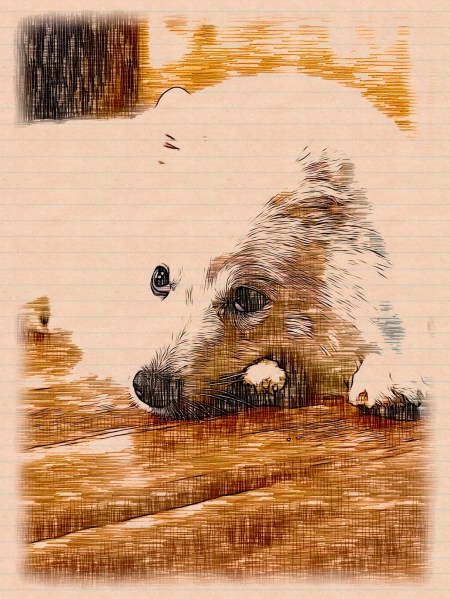
japanese spitz painting

Since childhood, Madam Setsuna had been afraid of being alone. Sometimes it was just a nagging anxiety, a persistent discomfort that lingered at the edges of her awareness. Other times, it became a full-blown panic at every sound. She feared the creaking of floorboards. The rustling of curtains frightened her. Even the gentle tap of branches against her window caused panic.

As a child, when her parents left her alone, she would avoid entering certain rooms. She was convinced that something terrifying was lurking behind the curtains. It seemed to be waiting to pounce. Her imagination painted monsters in the shadows, malevolent presences in empty corners. The rational part of her mind knew these fears were unfounded, but that knowledge did little to quell her terror.

Mysteriously, all these fears would vanish when her parents returned home or when her grandmother came to visit. Her grandmother’s presence was not particularly magical. She would simply bustle about in the kitchen by the stove. She hummed old folk tunes as she prepared tea or soup. Yet somehow, the entire house would transform. It became safe and cozy. Warmth seemed to radiate from her grandmother’s very being.

“There’s nothing to fear, little one,” her grandmother would say, stirring a pot of soup with practiced movements. “A house is just walls and a roof until you fill it with the right energy.”

Setsuna never quite understood what her grandmother meant by that, but she felt the difference. When her grandmother was there, the shadows retreated, and the corners of rooms no longer seemed to harbor threats.

This pattern continued well into Setsuna’s teenage years. She became adept at hiding her fears from friends and classmates, making excuses to avoid sleepovers or camping trips. She crafted a calm, composed exterior that masked the anxiety churning within. People came to see her as self-possessed and confident, never suspecting the dread she felt when left alone.

Everything changed on a damp October evening as she was returning from the grocery store. It had been raining all day, transforming the streets into mirrors that reflected the dim light of the streetlamps. The air was heavy with moisture, and a chill wind cut through Setsuna’s coat.

As she walked past a narrow alley, she heard a faint whimpering. Little Madam Setsuna slowed her pace, hesitating. Logic told her to keep walking—who knew what or who might be hiding in the darkness? But something—a feeling she couldn’t explain—made her turn into the alley.

In a cardboard box, soaked through from the rain, lay a puppy. It was a small bundle of white fur with extraordinary eyes the color of dark amber. Those eyes looked directly into her soul, fearless and filled with some ancient, unfathomable knowledge.

“What am I supposed to do with you?” Setsuna asked, already knowing the answer.

That was how Shadow entered her life—a dog of indeterminate breed but very determinate character. Shadow was white as milk. His eyes were the color of dark amber. He had an inexplicable sense of dignity that seemed to come from nowhere.

The first signs of Shadow’s unusual nature appeared just a week later. Madam Setsuna was returning from school along her usual route when the dog suddenly stopped. The fur on the back of her neck stood up, and a low, guttural growl emerged from her throat.

“What is it, girl?” Setsuna looked around but noticed nothing suspicious.

Shadow stubbornly pulled the leash in the opposite direction. Setsuna hesitated for a moment, then decided to trust the dog.

They took a different path home that day. It led through a small park. They chose this instead of the shortcut through the old apartment complex. Later that evening, Setsuna learned something shocking. A section of the old building’s facade had collapsed. Bricks and debris had crashed down to the very spot where she would have walked.

This became a pattern. Shadow seemed to sense dangers that were invisible to human perception. She would grow restless before thunderstorms, pacing the apartment hours before the first rumble of thunder. She would place herself between Setsuna and strangers who later proved to be untrustworthy. She would refuse to enter certain buildings or areas. It was as if she could see something ominous that human eyes could not detect.

As the weeks turned into months, Setsuna began to understand that Shadow was more than just a pet. She was a guardian and a protector. Her senses extended beyond the physical world.

Most importantly, with Shadow by her side, Setsuna’s fear of being alone gradually diminished. The apartment no longer felt empty and threatening when her parents were away. The corners no longer harbored imaginary monsters. Shadow’s presence filled the space. Setsuna felt the same sense of security that she had once felt only when her grandmother was around.

“You remind me of her.” Setsuna told Shadow one evening as they sat together on the couch. The rain pattered against the windows. “My grandmother. She made everything feel safe too.”

Shadow looked at her with those knowing amber eyes. She placed a paw gently on Setsuna’s hand. It was as if she wanted to show she understood perfectly.

As Setsuna grew older, her connection with Shadow deepened. They developed a silent language, an understanding that transcended words. Shadow seemed to know Setsuna’s thoughts before she voiced them, anticipating her needs and responding to unspoken requests.

When Setsuna went away to university, Shadow accompanied her. A special exception was made due to Setsuna’s “anxiety condition” (a simplified explanation she provided to the housing office). In their small campus apartment, Shadow continued her vigilant protection. She warned Setsuna away from certain people and situations. These situations invariably proved problematic.

It was during her university years that Setsuna began to truly question the nature of Shadow’s abilities. Was it simply heightened canine senses, or something more? She found herself drawn to courses in parapsychology, old religion and myths, and the study of human-animal bonds. Her academic interests extended from her original focus on math. She began focusing on interdisciplinary studies of phisics and biology. She also explored the boundaries between the known and the unknown.

One evening, while researching for a paper, Setsuna found a text.


Of the Borrowed Knowing and the Path of One’s Own Hearth ✧

I. The Nature of the Quiet Ones.
In the days of old, it was told that among the people, some have faint senses of safety. Their senses are as weak as a hearth where the embers do not catch. These ones do not look within for signs of danger. They also do not search for ease, as such knowing does not rise readily from their marrow.
Rather, they listen to the winds about them, and to the hearts of others.
Thus do they seek the company of those whose watchful eyes and quiet knowing bring steadiness to their wandering.

II. Of the Borrowed Light. It speaks of the Steady Companion.
The wise have said: A heart finds steadiness when such a one walks beside a soul of clear knowing. Be it man, woman, or beast. Their heart remains composed.
The strength of the other becomes as a lantern held aloft in the darkened wood. Many who walk with hounds or noble beasts find calm upon the path. The creature’s keen sense of peril becomes their own shield. And they think within themselves, Now am I safe, for my companion stands guard.

III. Of the Subtle Chains that Bind.
Heed this, O seeker of the way. That which is borrowed may become a chain. If the heart depends too much on another’s wisdom, the legs might soon forget to stand. They may not remember how to stand on their own upon the earth. And the voice within may grow faint, saying, “I can’t walk this road unless another walks beside me.” Thus may a man, or woman, or child give away their fire, Believing it not their own to tend.

IV. Right Companions and Right Remembrance.
Let it be known: One may walk in good measure. This balance lies between the gift of others and the fire within. Let the wise follow these ways:
➤ Recognize when the stillness belongs to you. Know when it is lent by another.
➤ Hold respect for the gifts of companionship, but do not take their light as thy rightful flame.
➤ Choose thy company with care; for some bear peace in their bosom, and others bring tempests.
➤ Always return to your heart’s own truth.

The time will come when the lamp of your knowledge is kindled.

V. Of Questions for the Road-Farer.
Let them ask who seek understanding upon their path.
➤ Who brings me peace, and asks nothing in return?
➤ When I walk alone, what sings in my bones?
➤ Am I willing to trust my own tide, even when the sea is silent, and the land unseen?

Thus spoke the elder creature to the wanderer, and thus was the teaching given. The wise remember: To walk beside is grace; to walk alone by thine own choosing is freedom.


It described humans and beings protected those with special sensitivities or destinies. The text suggested that such guardians often appeared to individuals with an unconscious ability. These individuals could perceive beyond the veil of ordinary reality.

“Is that what you are?” she asked Shadow, who lay at her feet, ears perking up at the sound of her voice. “Am I actually sensitive to something, rather than just being afraid?”

Shadow tilted her head, those amber eyes seeming to hold secrets of the universe. She made no sound, but Setsuna felt a strange warmth spread through her chest, a certainty that transcended rational explanation.

Over the years, Setsuna’s relationship with fear transformed. What had once been debilitating anxiety became a finely tuned awareness. With Shadow’s guidance, she learned to distinguish between irrational fear and genuine intuition. She began to trust the subtle signals her own body and mind provided. She learned how to be guided safe by own clarity of emotion in moments of potential danger.

“You’ve been teaching me all along, haven’t you?” she said to Shadow one day. They strolled along a forest path with the autumn leaves crunching beneath their feet. “Teaching me to listen to the same things you hear, to see what you see.”

Shadow wagged her tail, confirming Setsuna’s insight without needing words.

As the years passed, Setsuna became known for her uncanny insights and her fiarless presence in crisis situations. Friends and later colleagues were amazed by her ability to sense trouble before it manifested. They admired her skill in knowing which path to take when faced with difficult choices. They attributed it to wisdom or experience. They never suspected that her true education had come from a white dog with amber eyes. This dog had appeared on a rainy evening long ago.

Shadow lived far longer than any ordinary dog should. She remained vigorous and alert well past twenty years. Setsuna carefully obscured this fact from curious veterinarians and friends. But eventually, as all things must, Shadow began to slow down. Her white fur changed to a silver tint. She slept more often. Her amber eyes remained as bright and knowing as ever.

On a crisp autumn evening, it felt very much like the evening when they had first met. Shadow laid her head on Setsuna’s lap. She looked up with those extraordinary eyes.

“You know, don’t you?” Setsuna whispered, tears streaming down her face. “You know it’s time.”

Shadow nuzzled her hand gently, her tail thumping weakly against the couch.

That night, Setsuna held her guardian. Shadow took her last breath and passed peacefully. She did so in the arms of the woman she had protected for so long.

Madam Setsuna expected the old fears to return after Shadow’s death—the dread of empty rooms, the terror of solitude. But something strange happened instead. She found that yes, she felt old fears. Yet, now they didn’t bother her; she realized these fears were not her anymore.


She still sensed dangers and opportunities that others missed. She still knew which strangers to trust and which to avoid. She still sensed the approach of storms before the first clouds gathered. She missed feeling secure with her little Shadow behind her. She had to learn how to manage it herself.

Years later, on another rainy October evening, Madam Setsuna opened newspaper and saw a puppy eyes in an advertising. Suddenly, she feel the same feeling as many years ago in alley. This feeling was as a faint whimpering, barely audible above the patter of raindrops.

She paused, a smile playing at the corners of her mouth.

“Some things come full circle,” she murmured, press the button apply without hesitation.

In few days, she got a tiny puppy sat in a sodden cardboard box in a railway station. It had striking amber eyes. These eyes seemed to hold ancient wisdom and recognition as they met hers.

“Hello,” said Madam Setsuna, kneeling down despite the rain soaking through her expensive coat. “I’ve been waiting for you to find me again.”

The puppy tilted its head, those amber eyes seeming to smile.

And together, they walked home through the rain, beginning their journey once more.

The Case of the Mysterious Patches

The Case of the Mysterious Patches

The morning light filtered through the diamond-faceted windows of Whispering Pines Cottage, casting dappled patterns across the worn wooden floor. Madam Setsuna sat at her kitchen table, her steel cup cooling beside her. Her fingers, once nimble and quick, now moved with deliberate care as she massaged her wrist. The pain had become her unwelcome companion these past few years.

Strela, her Japanese Spitz, observed from her cushion by the glass door, her intelligent eyes tracking her mistress’s movements. The dog’s white fur caught the sunlight, creating a halo effect around her attentive form. Her glasses were a custom creation by Madam Setsuna. She had fashioned them after the dog developed vision problems. They reflected the morning light as she tilted her head in concern.

“Just the usual morning stiffness,” Madam Setsuna reassured her companion, though they both knew it was more than that. The ache had deepened, spread. It wasn’t just her joints now; every muscle in her body seemed to protest even the most mundane movements.

The Bialetti coffee maker gurgled its final notes on the Slovenian ceramic stove. Even reaching for the coffee had become an exercise in pain management. Madam Setsuna frowned slightly. This wouldn’t do. A detective with limited mobility was at a significant disadvantage.

“I believe it’s time to approach this methodically, Strela,” she announced, her voice calm despite the discomfort. “This pain is a mystery to be solved, like any other.”

Strela’s ears perked up. She recognized the tone—it was the same one Madam Setsuna used when beginning a new investigation. The dog rose from her cushion and padded over to sit attentively beside her mistress.


The family doctor’s office had been a disappointment. Despite blood tests and examinations, the conclusion was frustratingly vague: age-related arthritis, nothing unusual for someone of Madam Setsuna’s years. The doctor had prescribed anti-inflammatories and suggested gentle exercise.

“But this doesn’t explain the muscle pain,” Madam Setsuna had pointed out. She only received a sympathetic but unhelpful shrug in response.

Back at Whispering Pines Cottage, she spread her medical documents across the kitchen table. Strela watched her mistress slip into investigation mode. Her mistress examined each report with her magnifying glass. It was as if they were clues at a crime scene.

“The pain is not just in the joints. It radiates through the muscles,” she murmured, more to herself than to Strela. “The blood work shows nothing unusual. The doctor sees nothing extraordinary. So, we must look beyond the ordinary.”

This was how their investigations always began—with observation, documentation, and research. Madam Setsuna reached for her notebook, its leather cover worn smooth at the corners, and began to make notes.

She discovered a physiotherapy clinic not far from their cottage through her inquiries. It specialized in trigger point massage. This massage was specifically designed to release muscle tension. After several phone calls and discreet questions to neighbors who had visited the clinic, she decided it warranted investigation.

“We have an appointment in three weeks,” she informed Strela one evening. “I’ve heard interesting things about their approach.”


The red-brick building of the physiotherapy clinic in near city was surrounded by cars when Madam Setsuna arrived. Inside, the waiting room buzzed with conversation, filled mostly with elderly patients. The atmosphere was unexpectedly jovial, with doctors and patients exchanging light-hearted banter.

Madam Setsuna observed everything with quiet attention. The patients seemed genuinely happy, almost euphoric—unusual for people presumably in pain. She noted how the staff moved with confident efficiency, how the patients’ eyes followed them with something akin to reverence.

When her name wasn’t called, she approached the reception desk. She was told that her case was “complex.” It required consultation with their head – Dr. Fabiano.

“Doctor Fabiano,” the man introduced himself half an hour later, his handshake firm and confident. His qualifications hung framed on the wall. They included impressive qualifications and experience in various prestigious settings. There were also photographs showing him with Olympic athletes, including the women’s ski team.

His assessment was thorough but his conclusion surprised her.

“You could come for physiotherapy for six months,” he said, “or we could try our latest technology. Something revolutionary.”

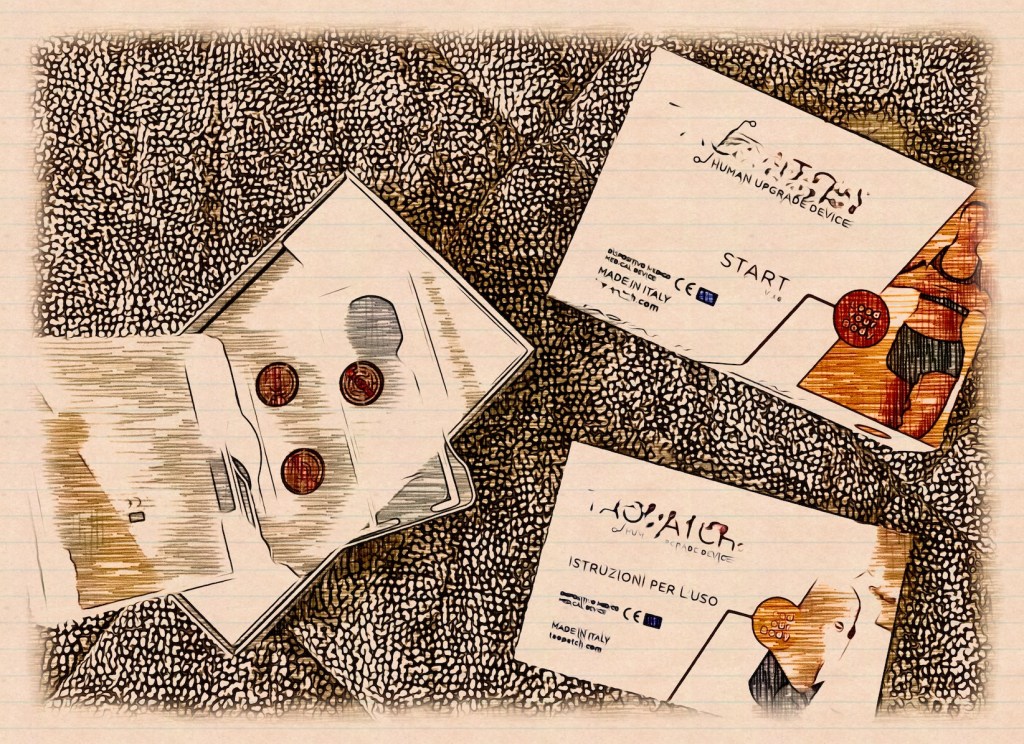
From a drawer, he produced small, round metallic discs.

“Tao-patches,” he explained. “Nano-crystals that work continuously to restore muscle balance. You wear them on specific points on your body, and they work twenty-four hours a day.”

Madam Setsuna’s skepticism was evident on her face. Fabiano quickly added, “Many of our patients have experienced remarkable results. The technology is cutting-edge.”

The investigator in her was intrigued, even as the rationalist raised questions. But with few alternatives and persistent pain, she agreed to try the patches.

Fabiano applied them to specific points on her body. He provided instructions for maintenance. He scheduled a follow-up appointment in one month.

“To share your experience,” he said with a smile that didn’t quite reach his eyes.


The drive back to Whispering Pines Cottage was filled with doubt. This wasn’t what she had expected—no massage, no conventional therapy, just these mysterious patches clinging to her skin.

Strela greeted her at the door, nose quickly drawn to the strange new scent on her mistress. The dog sniffed curiously at the patches, then backed away with an uncharacteristic whine.

“Yes, I’m suspicious too,” Madam Setsuna murmured, stroking the dog’s head. “But let’s watch and document, as we always do.”

She began a journal that evening, recording the placement of each patch and her physical sensations. By the third day, she noticed something unexpected: the muscle stiffness was subsiding. By the end of the week, her movements were more fluid than they had been in months. The joint pain remained, but the muscle tension—that constant, unyielding grip—had loosened.

“It’s almost miraculous,” she admitted to Strela one morning as she performed her stretches with greater ease. “But that’s precisely what concerns me.”

Miracles, in Madam Setsuna’s experience, warranted investigation.

She began researching the Tao-patches, combing through medical journals and scientific publications. Information was surprisingly scarce for a “revolutionary technology.” What she did find came mostly from patient testimonials. These included effusive praise and claims of life-changing results. Yet, there was little scientific explanation of how the patches actually worked.

One evening, she sat at her computer in the small study off the kitchen. Strela suddenly appeared at her side and dropped something onto the desk. It was one of the patches that had fallen off earlier in the day. The dog nudged it with her nose, then looked up at Madam Setsuna meaningfully.

“You think we should examine it more closely? Excellent suggestion, Strela.”

Under her powerful magnifying glass, the patch revealed little of its secrets. It appeared to be a simple metallic disc with adhesive backing. Nothing visibly special or “nano-technological” about it.

Madam Setsuna’s search deepened. She reached out to contacts in scientific fields. She posted inquiries on specialized forums. Finally, she discovered a worrying article online: “Taopatch: Is It a Scam?”

The article detailed allegations that the patches had no proven scientific basis. It stated that their claimed nanotechnology was fictitious. The placebo effect accounted for most reported improvements.

“Yet I feel better,” Madam Setsuna mused, flexing her fingers. “Objectively better.”

Strela tilted her head, her glasses sliding slightly down her snout.

“Yes, I know. The placebo effect is powerful indeed. But there’s something else at work here, I suspect.”

Her investigation took a new direction. Rather than focusing solely on the patches, she began observing the clinic’s operation more closely. During her follow-up visit, she arrived early. She lingered late. She observed the comings and goings and the interactions between staff and patients.

She noticed patterns. The same patients were returning weekly despite supposedly wearing 24/7 patches. The hushed conversations stopped when she approached. Fabiano’s eyes narrowed slightly when she asked detailed questions about the technology.

“Tell me,” she asked casually as he checked her patches, “how exactly do these nano-crystals interact with muscle tissue?”

His explanation was verbose but vague. It was full of scientific-sounding terminology. Upon later research, this terminology proved to be either misused or entirely fabricated.

On her third visit, Madam Setsuna arrived with a small, discreet device in her handbag. This device was a frequency scanner she borrowed from a former colleague. Doctor Fabiano applied a new patch to her neck. As he did so, the scanner detected a low-frequency electrical pulse. The pulse was emanating from the disc.

“Not nano-crystals,” she murmured to Strela that evening. “Simple electrical stimulation devices. Effective, certainly—but hardly revolutionary, and certainly not what they claim.”

The investigation was detailed. It showed that the clinic charged patients premium prices. They were paying for what was could be basic effect of kinesio tape. Madam Setsuna found out that many companies had already made kinezio tape technology available. They produced patches cost mere pennies to produce. They were remarkably easy to use. No specialist application was required.

“The question is,” she said to Strela as they sat by the ceramic stove. Its warmth soothed her still-aching joints. “Is this merely an unethical business practice, or something more sinister?”

The answer came unexpectedly. While organizing her papers one evening, she noticed a pattern. It was in the clinic’s patient records. She had managed to glimpse it during her visits. Those with the most “complex” cases—like herself—were predominantly older, financially comfortable, and living alone.

“They’re targeting vulnerable individuals,” she realized. “People desperate for relief, with the means to pay and without close family who might ask questions.”

Strela’s ears flattened against her head, a low growl rumbling in her throat.

“My thoughts exactly,” Madam Setsuna agreed.


The next morning dawned clear and crisp at Whispering Pines Cottage. Madam Setsuna sat at her kitchen table. She held the familiar weight of her steel cup in her hand. She watched as the sun rose over the pine trees. Her muscles ached less these days. This was partly due to the electrical stimulation of the patches. It was also partly due to the exercise regimen she had developed based on legitimate physiotherapy research.

Beside her lay a thick folder containing her entire investigation. It included photographic evidence of the patches’ interior components and frequency readings. There were also financial records showing the clinic’s pricing structure. She had carefully collected testimonials from other patients, many of whom had not experienced the relief they were promised.

“It’s time to conclude this case,” she told Strela, who sat attentively beside her chair. “The regional medical board will get our findings as part of my will.” She smiled wryly. “At least they have a duty to better organize pain care in evidence-based medicine routine.”

“The interesting thing about pain,” Madam Setsuna reflected. She watched as Strela settled into her favorite spot by the ceramic stove. “Understanding its source is half the battle.”

She was about to remove the last patch from her shoulder and place it into the evidence bag, but hesitated. The pain would return once she removed it. No matter what they called this technology, the small piece of metal was working. She had already paid for it. Strela sensed her mistress’s hesitation. She pressed her paw firmly on the evidence bag. It was as if to say this wasn’t the time to give up on the miracle patches. Their marketing might be dubious.

Outside, the pine trees whispered their secrets in the morning breeze. Inside Whispering Pines Cottage, Madam Setsuna closed her investigation notebook, adding one more solved mystery to her collection.

“Now,” she said to Strela, whose tail wagged in anticipation, “I believe we’ve earned ourselves a walk through the forest. These old joints may protest, but they’ll have to learn they cannot stop us.”

Together, detective and dog stepped out into the morning light. They were ready for whatever mystery awaited them next at the edge of the whispering pines.

The Manifestation Master: Madam Setsuna’s Tale

guest of madam Setsuna

The old cottage sits at the point where civilization politely excuses itself and lets the forest take over. Nestled in the Slovenian foothills of the Alps, it stands as a vision in white against the deep green of the forest, its walls weathered by countless seasons yet gleaming in the morning light. A red-tiled roof rises like a cheerful mushroom cap above the morning mist, with dark wooden balustrades running along the upper terrace, and a foundation of rough-hewn stone that rises from the earth as if it grew there naturally.

Pine trees whisper their secrets around it, giving the cottage its name and protecting it from the world beyond. Everyone knows it as “Whispering Pines Cottage” – the little house at the edge – though Madam Setsuna simply calls it home.

The morning had begun like most others at Whispering Pines. Madam Setsuna, with her distinctive red, graying curly hair and large round-framed glasses, performed her coffee ritual with practiced precision. The octagonal Bialetti Moka maker fit perfectly atop the traditional Slovenian ceramic stove, its bubbling sounds mingling with morning birdsong. Strela, her wise 12-year-old Japanese Spitz, maintained her observation post by the glass door, her white fur catching the first hints of sunrise through the diamond-faceted windows.

But today would be different. As the familiar gurgling sound of the Moka maker signaled that breakfast was nearly ready, Madam Setsuna made a decision.

“Strela,” she said, pouring the rich brew into her steel cup with the triangular handle, “I believe it’s time we shared what we’ve learned about manifestation.”

Strela’s ears perked up, her intelligent eyes meeting Setsuna’s gaze in silent understanding. The dog’s own glasses – a charming affectation that somehow suited her dignified demeanor – caught the morning light as she tilted her head inquisitively.

“Yes, I know,” Setsuna smiled. “It’s not our usual type of investigation. But this mystery – why some people manifest their desires while others don’t – it’s perhaps the most important one we’ve encountered.”

By evening, the kitchen had been transformed. The copper pots still hung from rough wooden beams, sharing space with delicate Japanese tea cups, but now the central table was cleared and cushions arranged in a circle. Herbs bundles hung from the ceiling, their subtle fragrance filling the air with purpose rather than mere pleasantness.

As the clock in the hall chimed seven, there came a gentle knock at the heavy wooden door. Strela barked once, a soft, welcoming sound, then sat primly as Setsuna welcomed her guests. They were a curious assortment – the postmaster from the village below, a university researcher from Ljubljana, an elderly herbalist from the mountains, and four others, each carrying the invisible weight of unfulfilled desires.

“Welcome to Whispering Pines,” Setsuna said, her calm demeanor immediately setting the tone. She didn’t begin with introductions or pleasantries. As an investigator, she knew the power of observation before interaction. She watched how each person chose their seat, noted their posture, cataloged the micro-expressions that flashed across their faces.

Strela settled beside Setsuna’s chair, watchful and alert – her faithful companion in this unusual investigation.

“Meet people for whom everything comes true,” she finally said, her investigator’s voice clear and precise behind her round glasses. “This is what a person will not say has happened. Raise your hand, who has seen such people.”

Three hesitant hands went up.

“Raise your hand, those who are such a person.”

One hand—the herbalist’s—rose halfway before faltering.

“Raise your hand, those for whom this is always the case.”

No hands rose.

Madam Setsuna adjusted her glasses with a practiced gesture, as if confirming a theory. “Less and less. Cool! Now I will tell you the secret of these people.”

She rose and walked to an ancient wooden cabinet, retrieving seven small mirrors that gleamed in the soft light. She placed one in front of each person before returning to her seat. Strela watched the proceedings with intense focus, her white fur almost glowing in the evening light.

“People for whom all wishes come true, these are people who are integral on all levels. That is, what happens on the energy level flows through their entire structure and through their entire being as a single whole.”

The postmaster scoffed quietly.

“Mr. Novak,” Madam Setsuna said without looking at him, applying her detective’s insight, “yesterday at the market, you helped an elderly woman with her packages, yes?”

The postmaster’s eyes widened. “How did you—”

“But at the same moment, you were resentful. Your mind was calculating the minutes lost. Your heart was generous, your energy was kind, but your thoughts were elsewhere. Fragmented.” Her tone was not accusatory but analytical—the same tone she used when unraveling the threads of her most perplexing cases.

The university researcher gasped. Madam Setsuna turned to her with the swift precision that had made her renowned for solving even the most baffling mysteries.

“Ms. Kovač, you’ve been studying ancient Slovenian folklore for your thesis. You perform the research diligently, you speak passionately about your findings, but deep within, you believe your interpretations are flawed. Your desires and beliefs conflict. Fragmented.”

Strela stood and moved to the center of the circle, sensing the tension. She settled there, her white fur and wise eyes drawing everyone’s attention as Setsuna looked around the gathering.

“When we are disunited, when one thing happens on the energy level, another happens on the emotional level, a third happens on the feeling level—thus we go against ourselves.”

Madam Setsuna stood and joined Strela in the center of the circle. The dog sat regally beside her, a calm, steady presence.

“I always say, you don’t understand that everything that happens in your life—the saleswoman at the checkout—she is not a coincidence either. It is exactly this moment. Someone said something, someone did something, you saw someone, YouTube showed you something. I say, none of this is a fucking coincidence.”

The unexpected profanity made the herbalist laugh and broke the tension in the room. Even Strela seemed to smile, her mouth curving slightly upward.

“It is all given to you so that you can go along the line of your life,” Setsuna continued, her investigator’s mind connecting patterns others couldn’t see. “But you must be whole to see it. You must align. This is the case I’ve been solving my entire life.”

She gestured to the mirrors. “Look not at your reflection, but through it. See all your parts—the hopeful, the doubtful, the brave, the frightened. Acknowledge them all as one being—you. This is the evidence we’re looking for.”

Strela moved around the circle, stopping briefly at each person, offering her own brand of wisdom as Setsuna guided them through an exercise of internal alignment. By the end, the postmaster’s shoulders had relaxed. The researcher’s anxious fidgeting had ceased. The herbalist was smiling serenely.

“Practice this daily,” Madam Setsuna instructed as people prepared to leave, adjusting her round glasses with the authority of someone who had solved hundreds of mysteries. “Alignment isn’t achieved once and forever. It’s a practice, a way of moving through the world. I’ve investigated many phenomena in my time, but this is the most important mystery I’ve ever solved.”

As they filed out into the mist-kissed evening, each carried something intangible yet palpable—a sense that perhaps the world wasn’t random chaos after all, but a reflection of their internal state.

The last to leave was the herbalist. She paused at the door, Strela watching curiously from her cushion.

“It worked for me once,” she said quietly. “Years ago. For one perfect summer, everything I wished aligned with everything I believed, everything I felt, everything I was. Everything came true.”

“And then?” Madam Setsuna asked, the investigator in her needing to complete the story.

“Life happened. I fragmented again.” The herbalist smiled sadly, nodding respectfully to Strela. “But I remember what it felt like. To be whole.”

Madam Setsuna nodded. “That memory is a compass. It can guide you back. All good investigations begin with a single clue.”

After everyone had gone, Madam Setsuna and Strela returned to the kitchen. She picked up each mirror, wiping it clean before returning it to the wooden cabinet. Strela helped in her way, her keen senses alert for anything out of place in their harmonious home.

Outside, the mist had thickened around Whispering Pines. The cottage glowed like a lantern in the darkness, a beacon at the edge of the forest. Madam Setsuna stepped onto the porch, Strela at her heels, and breathed in the pine-scented air.

A deer appeared at the edge of the clearing, its eyes reflecting the light from the cottage. Without surprise, Setsuna reached into her pocket and pulled out an apple she’d placed there that morning—exactly enough for this encounter.

Strela sat quietly, understanding this was not prey to be chased but part of the greater mystery her mistress navigated so effortlessly.

Just another non-coincidence on the perfectly aligned path of Madam Setsuna, the brilliant investigator with red curly hair and round glasses, who had turned her deductive powers toward the greatest mystery of all—the human spirit—with her wise Japanese Spitz always by her side.