Since childhood, Madam Setsuna had been afraid of being alone. Sometimes it was just a nagging anxiety, a persistent discomfort that lingered at the edges of her awareness. Other times, it became a full-blown panic at every sound. She feared the creaking of floorboards. The rustling of curtains frightened her. Even the gentle tap of branches against her window caused panic.
As a child, when her parents left her alone, she would avoid entering certain rooms. She was convinced that something terrifying was lurking behind the curtains. It seemed to be waiting to pounce. Her imagination painted monsters in the shadows, malevolent presences in empty corners. The rational part of her mind knew these fears were unfounded, but that knowledge did little to quell her terror.
Mysteriously, all these fears would vanish when her parents returned home or when her grandmother came to visit. Her grandmother’s presence was not particularly magical. She would simply bustle about in the kitchen by the stove. She hummed old folk tunes as she prepared tea or soup. Yet somehow, the entire house would transform. It became safe and cozy. Warmth seemed to radiate from her grandmother’s very being.
“There’s nothing to fear, little one,” her grandmother would say, stirring a pot of soup with practiced movements. “A house is just walls and a roof until you fill it with the right energy.”
Setsuna never quite understood what her grandmother meant by that, but she felt the difference. When her grandmother was there, the shadows retreated, and the corners of rooms no longer seemed to harbor threats.
This pattern continued well into Setsuna’s teenage years. She became adept at hiding her fears from friends and classmates, making excuses to avoid sleepovers or camping trips. She crafted a calm, composed exterior that masked the anxiety churning within. People came to see her as self-possessed and confident, never suspecting the dread she felt when left alone.
Everything changed on a damp October evening as she was returning from the grocery store. It had been raining all day, transforming the streets into mirrors that reflected the dim light of the streetlamps. The air was heavy with moisture, and a chill wind cut through Setsuna’s coat.
As she walked past a narrow alley, she heard a faint whimpering. Little Madam Setsuna slowed her pace, hesitating. Logic told her to keep walking—who knew what or who might be hiding in the darkness? But something—a feeling she couldn’t explain—made her turn into the alley.
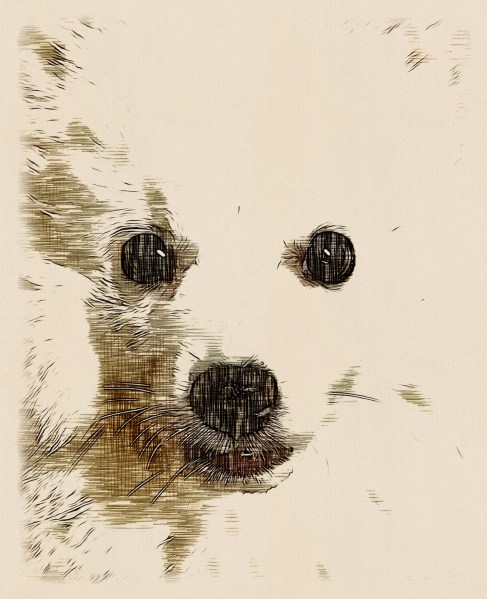
In a cardboard box, soaked through from the rain, lay a puppy. It was a small bundle of white fur with extraordinary eyes the color of dark amber. Those eyes looked directly into her soul, fearless and filled with some ancient, unfathomable knowledge.
“What am I supposed to do with you?” Setsuna asked, already knowing the answer.
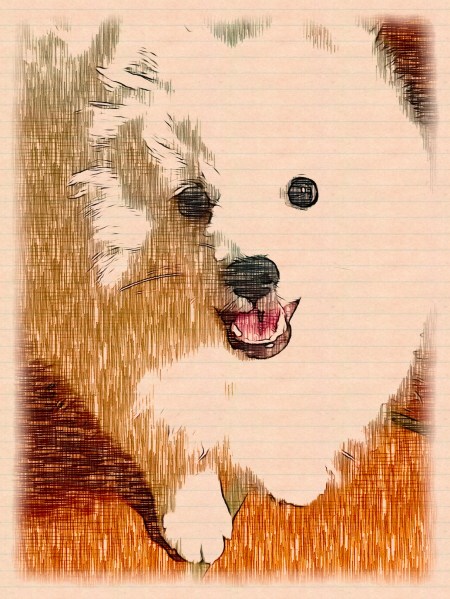
That was how Shadow entered her life—a dog of indeterminate breed but very determinate character. Shadow was white as milk. His eyes were the color of dark amber. He had an inexplicable sense of dignity that seemed to come from nowhere.
The first signs of Shadow’s unusual nature appeared just a week later. Madam Setsuna was returning from school along her usual route when the dog suddenly stopped. The fur on the back of her neck stood up, and a low, guttural growl emerged from her throat.
“What is it, girl?” Setsuna looked around but noticed nothing suspicious.
Shadow stubbornly pulled the leash in the opposite direction. Setsuna hesitated for a moment, then decided to trust the dog.
They took a different path home that day. It led through a small park. They chose this instead of the shortcut through the old apartment complex. Later that evening, Setsuna learned something shocking. A section of the old building’s facade had collapsed. Bricks and debris had crashed down to the very spot where she would have walked.
This became a pattern. Shadow seemed to sense dangers that were invisible to human perception. She would grow restless before thunderstorms, pacing the apartment hours before the first rumble of thunder. She would place herself between Setsuna and strangers who later proved to be untrustworthy. She would refuse to enter certain buildings or areas. It was as if she could see something ominous that human eyes could not detect.
As the weeks turned into months, Setsuna began to understand that Shadow was more than just a pet. She was a guardian and a protector. Her senses extended beyond the physical world.
Most importantly, with Shadow by her side, Setsuna’s fear of being alone gradually diminished. The apartment no longer felt empty and threatening when her parents were away. The corners no longer harbored imaginary monsters. Shadow’s presence filled the space. Setsuna felt the same sense of security that she had once felt only when her grandmother was around.
“You remind me of her.” Setsuna told Shadow one evening as they sat together on the couch. The rain pattered against the windows. “My grandmother. She made everything feel safe too.”
Shadow looked at her with those knowing amber eyes. She placed a paw gently on Setsuna’s hand. It was as if she wanted to show she understood perfectly.
As Setsuna grew older, her connection with Shadow deepened. They developed a silent language, an understanding that transcended words. Shadow seemed to know Setsuna’s thoughts before she voiced them, anticipating her needs and responding to unspoken requests.
When Setsuna went away to university, Shadow accompanied her. A special exception was made due to Setsuna’s “anxiety condition” (a simplified explanation she provided to the housing office). In their small campus apartment, Shadow continued her vigilant protection. She warned Setsuna away from certain people and situations. These situations invariably proved problematic.
It was during her university years that Setsuna began to truly question the nature of Shadow’s abilities. Was it simply heightened canine senses, or something more? She found herself drawn to courses in parapsychology, old religion and myths, and the study of human-animal bonds. Her academic interests extended from her original focus on math. She began focusing on interdisciplinary studies of phisics and biology. She also explored the boundaries between the known and the unknown.
One evening, while researching for a paper, Setsuna found a text.
Of the Borrowed Knowing and the Path of One’s Own Hearth ✧
I. The Nature of the Quiet Ones.
In the days of old, it was told that among the people, some have faint senses of safety. Their senses are as weak as a hearth where the embers do not catch. These ones do not look within for signs of danger. They also do not search for ease, as such knowing does not rise readily from their marrow.
Rather, they listen to the winds about them, and to the hearts of others.
Thus do they seek the company of those whose watchful eyes and quiet knowing bring steadiness to their wandering.
II. Of the Borrowed Light. It speaks of the Steady Companion.
The wise have said: A heart finds steadiness when such a one walks beside a soul of clear knowing. Be it man, woman, or beast. Their heart remains composed.
The strength of the other becomes as a lantern held aloft in the darkened wood. Many who walk with hounds or noble beasts find calm upon the path. The creature’s keen sense of peril becomes their own shield. And they think within themselves, Now am I safe, for my companion stands guard.
III. Of the Subtle Chains that Bind.
Heed this, O seeker of the way. That which is borrowed may become a chain. If the heart depends too much on another’s wisdom, the legs might soon forget to stand. They may not remember how to stand on their own upon the earth. And the voice within may grow faint, saying, “I can’t walk this road unless another walks beside me.” Thus may a man, or woman, or child give away their fire, Believing it not their own to tend.
IV. Right Companions and Right Remembrance.
Let it be known: One may walk in good measure. This balance lies between the gift of others and the fire within. Let the wise follow these ways:
➤ Recognize when the stillness belongs to you. Know when it is lent by another.
➤ Hold respect for the gifts of companionship, but do not take their light as thy rightful flame.
➤ Choose thy company with care; for some bear peace in their bosom, and others bring tempests.
➤ Always return to your heart’s own truth.
The time will come when the lamp of your knowledge is kindled.
V. Of Questions for the Road-Farer.
Let them ask who seek understanding upon their path.
➤ Who brings me peace, and asks nothing in return?
➤ When I walk alone, what sings in my bones?
➤ Am I willing to trust my own tide, even when the sea is silent, and the land unseen?
Thus spoke the elder creature to the wanderer, and thus was the teaching given. The wise remember: To walk beside is grace; to walk alone by thine own choosing is freedom.
It described humans and beings protected those with special sensitivities or destinies. The text suggested that such guardians often appeared to individuals with an unconscious ability. These individuals could perceive beyond the veil of ordinary reality.
“Is that what you are?” she asked Shadow, who lay at her feet, ears perking up at the sound of her voice. “Am I actually sensitive to something, rather than just being afraid?”
Shadow tilted her head, those amber eyes seeming to hold secrets of the universe. She made no sound, but Setsuna felt a strange warmth spread through her chest, a certainty that transcended rational explanation.
Over the years, Setsuna’s relationship with fear transformed. What had once been debilitating anxiety became a finely tuned awareness. With Shadow’s guidance, she learned to distinguish between irrational fear and genuine intuition. She began to trust the subtle signals her own body and mind provided. She learned how to be guided safe by own clarity of emotion in moments of potential danger.
“You’ve been teaching me all along, haven’t you?” she said to Shadow one day. They strolled along a forest path with the autumn leaves crunching beneath their feet. “Teaching me to listen to the same things you hear, to see what you see.”
Shadow wagged her tail, confirming Setsuna’s insight without needing words.
As the years passed, Setsuna became known for her uncanny insights and her fiarless presence in crisis situations. Friends and later colleagues were amazed by her ability to sense trouble before it manifested. They admired her skill in knowing which path to take when faced with difficult choices. They attributed it to wisdom or experience. They never suspected that her true education had come from a white dog with amber eyes. This dog had appeared on a rainy evening long ago.
Shadow lived far longer than any ordinary dog should. She remained vigorous and alert well past twenty years. Setsuna carefully obscured this fact from curious veterinarians and friends. But eventually, as all things must, Shadow began to slow down. Her white fur changed to a silver tint. She slept more often. Her amber eyes remained as bright and knowing as ever.
On a crisp autumn evening, it felt very much like the evening when they had first met. Shadow laid her head on Setsuna’s lap. She looked up with those extraordinary eyes.
“You know, don’t you?” Setsuna whispered, tears streaming down her face. “You know it’s time.”
Shadow nuzzled her hand gently, her tail thumping weakly against the couch.
That night, Setsuna held her guardian. Shadow took her last breath and passed peacefully. She did so in the arms of the woman she had protected for so long.
Madam Setsuna expected the old fears to return after Shadow’s death—the dread of empty rooms, the terror of solitude. But something strange happened instead. She found that yes, she felt old fears. Yet, now they didn’t bother her; she realized these fears were not her anymore.
She still sensed dangers and opportunities that others missed. She still knew which strangers to trust and which to avoid. She still sensed the approach of storms before the first clouds gathered. She missed feeling secure with her little Shadow behind her. She had to learn how to manage it herself.
Years later, on another rainy October evening, Madam Setsuna opened newspaper and saw a puppy eyes in an advertising. Suddenly, she feel the same feeling as many years ago in alley. This feeling was as a faint whimpering, barely audible above the patter of raindrops.
She paused, a smile playing at the corners of her mouth.
“Some things come full circle,” she murmured, press the button apply without hesitation.
In few days, she got a tiny puppy sat in a sodden cardboard box in a railway station. It had striking amber eyes. These eyes seemed to hold ancient wisdom and recognition as they met hers.
“Hello,” said Madam Setsuna, kneeling down despite the rain soaking through her expensive coat. “I’ve been waiting for you to find me again.”
The puppy tilted its head, those amber eyes seeming to smile.
And together, they walked home through the rain, beginning their journey once more.
 Stories of Madam Setsuna