The Voice That Bridged Time
The morning light at Whispering Pines Cottage filtered through the diamond-faceted windows. It cast geometric patterns across the rough-tiled floor. These patterns were like ones Madam Setsuna had seen decades earlier. She had forgotten the name of the place until today. Strela maintained her vigilant position by the glass door. Her white fur was luminous in the morning glow. Meanwhile, Madam Setsuna performed her ritual with the Bialetti coffee maker.
Steam rose in delicate spirals as the familiar gurgling sound announced coffee’s readiness. The BBC Radio 4 documentary played in the background—”The White Island: Ibiza’s Hidden History.” It was pleasant but unremarkable. A particular voice emerged from the speakers. It caused Madam Setsuna’s hand to halt mid-pour, with coffee suspended in a perfect arc between pot and cup.
“People misunderstand what made Sandy’s Bar special,” the voice said, its Irish lilt mellowed by decades in the Mediterranean sun. “It was not about mix what some discerning folks would call a perfect Bloody Mary. It wasn’t the location—a converted hen-house on an unpaved street, for heaven’s sake. It was the collision of worlds that happened there. From midday onwards, a delightful medley of characters would gather. Amiable old expatriates shared tales of distant homes. Visiting actors and artists sketched or recited impromptu verses. Colorful Ibizans told stories stretching back generations. An assortment of eccentric locals joined in. Their peculiarities were accepted as natural embellishments to the island’s tapestry. Tourists finding conversations they’d remember long after they’d forgotten the beaches.”
The voice continued, resonant and reflective. “That’s why El Caballo Negro became what it was—a crossroads where lives intersected. Sometimes it was just for an evening, and sometimes it was for decades. Artists, musicians, locals, tourists, and yes, even the occasional spiritual seeker. Everyone was welcome, provided they brought good conversation.”
The coffee trickled over the rim of the cup, pooling on the countertop, but Madam Setsuna didn’t notice. Her attention was wholly captured by this unexpected intrusion from the past. It was a voice that had been filed away in her memory so completely. She hadn’t known it was there until this moment.
“That was Sandy Pratt,” the interviewer concluded, “legendary proprietor of Sandy’s Bar—otherwise known as El Caballo Negro. It was located in a former hen-house on an unpaved street in the fishing village of Santa Eulalia. The location became a gathering place for the island’s creative community. This occurred from the 1960s through the 1990s. Notable residents often visited the bar. These included Joni Mitchell, Nico from the Velvet Underground, and actor Terry Thomas. Terry Thomas, as Sandy just told us, drove a car painted with flowers to match one of his shirts.”
Strela, with the intuition that made her such a perfect companion, sensed the shift in her human’s demeanor. She padded across the room. She tilted her head inquiringly. Her glasses caught the morning light in a flash. It seemed to punctuate the moment’s significance.
“Strela,” Madam Setsuna whispered, her voice carrying the tremor of one who has seen a ghost, “I know that voice. I’ve heard it before… but I never knew his name until this moment.”
She abandoned the spilled coffee and moved to her armchair. She sank into it as memories long submerged rose to the surface. They emerged like air bubbles from the depths of a forgotten sea.
“It was September 1993,” she began, her gaze fixed on something Strela couldn’t see. “I was twenty-plus, just beginning to find my footing in system analysys after completing my mathematics degree. I had received my first proper paycheck—a sum that seems laughably small now but felt like a fortune then.”
Her lips curved into a smile at the memory of her younger self’s impulsivity. “I could have paid off student loans. I could have invested in professional attire as any sensible young woman would have done. Instead, I walked into a travel agency on a whim. I booked a week on an island I knew nothing about, beyond its reputation for hedonism. ‘Tour for Ibiza,’ I said. ‘As soon as possible.’ The agent looked at me as if I’d sprouted a second head. I was a solitary young woman with serious glasses and sensible shoes. I was bound for the party capital of Europe.”
Strela settled at her feet. Her posture communicated that she understood the gravity of what was unfolding. This wasn’t merely reminiscence. It was revelation.
The Black Horse’s Haven
“Ibiza in 1993 was at a fascinating crossroads.” Madam Setsuna continued. Her voice took on the measured cadence she used when piecing together a complex puzzle. “The massive commercialization of its club scene hadn’t yet reached its peak. There was still something raw and authentic beneath the emerging gloss. Some pockets of the island remained true to the bohemian spirit. This spirit had drawn artists and free-thinkers there since the 1960s.”
The young Setsuna of those days hadn’t planned to discover any of this authenticity. Her ferry had taken her to Ibiza Town. She dutifully explored the beaches. She also visited the nightclubs that tourists were expected to visit. She had danced at Pacha and Amnesia. She watched the sunset at Café del Mar. She wandered the fortified old town with its winding cobblestone streets.
“I met a group of Germans at a beach party. They convinced me to venture beyond the typical tourist circuit,” she recalled. “They spoke of Sta Eulalia with a reverence that piqued my curiosity. They described it as ‘the real Ibiza,’ whatever that meant to them. I allowed myself to be persuaded. I did not realize this casual decision would alter the trajectory of my life in unforeseen ways.”
Only on my final day did I realize the complication this side trip had created. I was standing at the bus station in Santa Eulalia. I discovered that returning to Ibiza Town and the ferry port would be far more difficult than anticipated.
“I need to reach the Port of Ibiza today,” she had explained to the clerk. He was a young man with black, slightly curly hair. He seemed perpetually amused by the predicaments of tourists.
“Not possible today, señorita,” he had replied. He shrugged with the practiced indifference of one who had delivered this news countless times. “There’s a festival and all our vehicles are committed there. Tomorrow morning is the soonest.”
His casual dismissal of her carefully planned itinerary had filled the young Setsuna with a mixture of anxiety. She also felt indignation that seemed, in retrospect, laughably disproportionate. Missing her ferry led to rearranging her flight. She had to explain her absence to her new employers. Most distressingly to her methodical mind, it meant deviating from a schedule.
She was stranded with hours to wait and no solution in sight. She had wandered the quiet streets of Santa Eulalia. It was a town that existed defiantly. It went against the pulsing energy defining the island’s more famous destinations. Here, elderly men played backgammon in the shade of orange trees. Fishermen mended nets by the harbor. Life moved at the unhurried pace of a place that had nothing to prove.
As afternoon shadows lengthened, her frustration gradually gave way to resignation. She found herself on a narrow, unpaved street. She stood facing an establishment whose weathered sign read “El Caballo Negro”—The Black Horse.
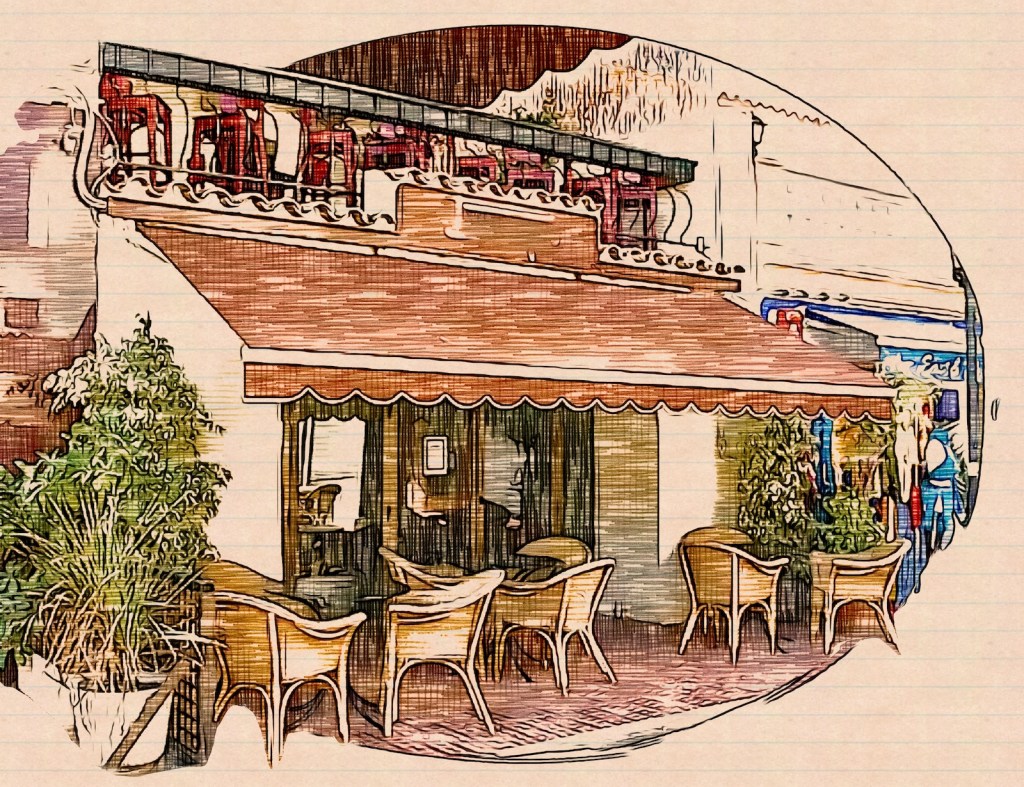
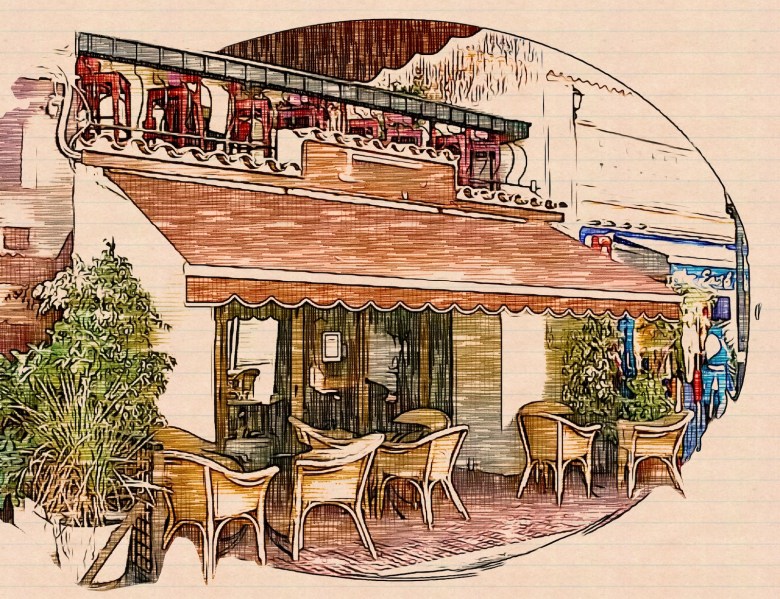
“There was nothing remarkable about its exterior,” Madam Setsuna told Strela. “Nothing that would suggest its significance—either to the island’s cultural history or to my personal future. Just another whitewashed building with a wooden door and shuttered windows. But something drew me in—perhaps simply the promise of shade and something cold to drink while I contemplated my predicament.”
The transition from the harsh Mediterranean sun to the bar’s cool interior temporarily blinded her. As her eyes adjusted, the first thing she noticed was the quality of light. It filtered through small diamond-shaped panes in the windows. These patterns across the rough-tiled floor seemed almost deliberately placed. It was as if the sun itself were an accomplice in the bar’s mysterious atmosphere.
“I remember the sensation of crossing a threshold that was more than merely physical,” she said. “It was as though I’d stepped from one realm of existence into another. I moved from the predictable world of schedules and expectations into a space where different rules applied. I couldn’t have articulated what those rules might be.”
She approached the bar. She ordered coffee from the man she now knew to be Sandy. He was a tall, fair-haired, fine-featured Irishman. His quiet demeanor belied a sharp observational intelligence. He nodded at her ask. He did not comment. He turned to prepare the coffee with the unhurried precision. He was like one who believes that anything worth doing is worth doing properly.
The young madam Setsuna found a small table in the corner. It gave her an excellent vantage point to watch the room. Even then, her cryptographer’s mind was constantly collecting and cataloging details, searching for patterns in the seemingly random.
The décor of El Caballo Negro was an education in itself—a physical chronicle of decades of island life. Paintings of varying quality hung alongside black-and-white photographs of faces both famous and unknown. Shelf-lined walls heaved with books in multiple languages, their spines faded by sun and handling. Every available surface was occupied by objects. These objects were classified as either art or artifacts, depending on one’s perspective. The collection included driftwood sculptures, antique nautical instruments, and ceramics. These ceramics had the unmistakable organic quality of local craftsmanship.
“It hadn’t been designed as a space,” Madam Setsuna explained to Strela. “Instead, it had evolved. Each object earned its place through some significance known perhaps only to Sandy himself. The result was an environment that felt random. It also felt perfectly calibrated, like walking into the physical manifestation of someone’s memory palace.”
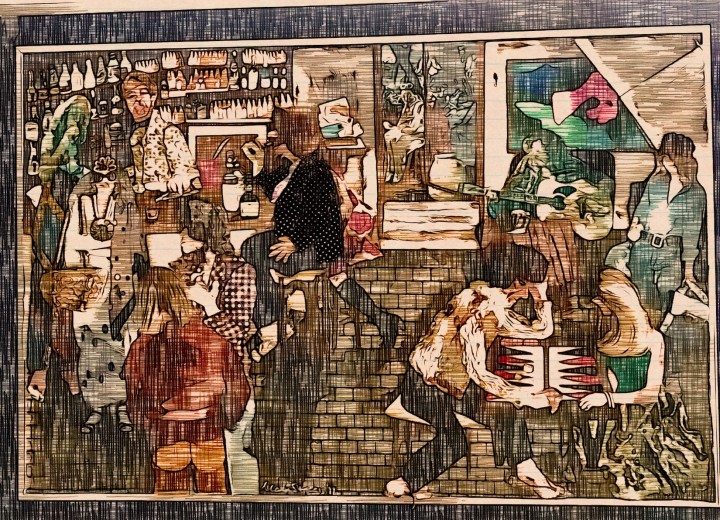
The patrons were as diverse as the décor. Several obvious tourists leafed through guidebooks. They looked somewhat bewildered at having stumbled upon a place so distinctly not marketed to them. Near the window, two men with the unmistakable look of artists debated some point of an art object. They discussed this with passionate intensity. For them, art is not abstract concepts. It is matters of life and death. A beat-up guitar accompanied them by improvised percussion. A song might start as a whisper and swell into a small, holy event.
Ah, yes—backgammon. At El Caballo Negro, the game wasn’t just a pastime. It was a quiet ritual. It was performed mostly by the elder locals—men with sun-browned hands and deeply lined faces. Their expressions rarely changed whether they won or lost. Their weathered hands moved with the fluid certainty that comes from decades of the same motions. Madam Setsuna always watched. She might have noted:
• The rules were never taught. People assumed you were either born knowing them. Or you were not meant to learn.
• Moves were made without hesitation, but not hurried. As if memory and instinct played the game, not thought.
• Bets were never spoken aloud. They were settled in gestures—a nod, a shrug, a half-smile with eyes still on the board.
• Conversations unfolded between the rolls: murmured gossip, political jabs, nostalgic sighs. Occasionally, a bit of singing, usually off-key.
• One man always chewed on a matchstick. Another never wore shoes. A third had a notebook he never wrote in.
It wasn’t just backgammon—it was a kind of ritual grounding. It was a sign. While the world outside spun wildly with tourists, dancers, seekers, and noise, this corner of the bar remained constant. Like the stones of Santa Eulalia’s harbor wall.
But it was the gathering at the bar that gradually commanded the young Setsuna’s attention. Four or five people were gathered around a man who seemed to be forty-five or fifty. His physical presence was overshadowed by the focused intensity he projected. He spoke with measured authority about concepts. These concepts seemed to bridge science and metaphysics. His hands occasionally sketched geometric patterns in the air to illustrate particularly complex points.
“I hadn’t meant to eavesdrop,” Madam Setsuna admitted. “His voice carried clearly across the room. Once I began listening, I found I couldn’t stop. He discussed a system blending astronomy, quantum physics, genetics, and ancient religios traditions. He explained how understanding one’s genetic design could help individuals better use their energy. This understanding aids in making decisions and engaging with the world in a fulfilling way.”
Her attention was captured not by the content itself. Her scientifically trained mind would normally have dismissed it as pseudoscience. But, it was the mathematical precision with which he articulated these concepts that intrigued her. He spoke clearly. He discussed “gates” and “channels.” He mentioned “defined and undefined centers.” He addressed “strategy and authority” with the clarity of a mathematician explaining a complex theorem.
“It wasn’t his appearance that caught my attention,” Madam Setsuna recalled. “It was the structure of his language. Having just completed my mathematics degree, I was attuned to patterns, to the architectural blueprint beneath complex information. This man spoke about esoteric concepts with the rigor of a scientist presenting empirical findings.”
The young madam Setsuna had found herself leaning ahead slightly. She strained to catch every word as he explained. Her reaction was without consciously deciding to. He detailed how each person’s birth data—exact time, date, and location—could be used to calculate a “body graph.” This graph revealed their authentic nature and optimal decision-making strategy.
“He said that most people live their lives following mental strategies. They analyze, calculate, and weigh pros and cons. Many aren’t designed to make decisions that way at all,” Madam Setsuna told Strela. “Some, he said, are designed to respond to their environment. Others wait for recognition. Still others feel the truth in their physical bodies.”
As she listened, something resonated deep within her. It was not intellectual agreement but a visceral recognition. This recognition made the fine hairs on her arms stand on end. She had no context for what she was hearing, no framework to evaluate its validity or significance. Yet something about it broke through her habitual skepticism and touched a deeper knowing she hadn’t realized she possessed.
“I remained there for several hours,” Madam Setsuna said, “far longer than I’d intended. At some point, a local fisherman at a nearby table overheard my predicament about the ferry. He offered me a ride to the port in his boat—for a fee, of course, but reasonable enough. I accepted, made my ferry, and returned to home and my budding career.”
She paused, her fingers tracing the rim of her now-cold coffee cup. “And I forgot about that afternoon in El Caballo Negro. Or so I believed.”
The Metamorphosis Beneath Awareness
“I didn’t understand something then.” Madam Setsuna continued, her voice softer now, reflective. “Something fundamental had shifted inside me. This shift occurred during those few hours. The seeds of change had been planted, though they would take years to fully germinate.”
“Dear Strela, I just realized something important. The words I had heard that afternoon left me questioning ideas. These were ideas I had earlier taken for granted. Was the universe truly as separated as my scientific training had led me to believe? Or were there intricate connections between individuals and the cosmos that science was only beginning to glimpse? These questions challenged the foundation of my rationalist worldview, making me reconsider the nature of consciousness and decision-making. What is real mechanistic of Universe? “
“Most profoundly,” she told Strela, “it introduced the notion that our existence transcends the boundaries we perceive. We are not isolated individuals moving through space and time. Instead, we are interconnected aspects of a larger cosmic design. We constantly evolve through our interactions.”
After my Ibiza trip, “I began to see patterns where others saw only random behavior,” she explained. “I noticed I could feel how different person would do, often with an accuracy that startled my colleagues. When they asked how I knew, I couldn’t articulate it. Chaos appeared an order that needs to be deciphered. I simply perceived the underlying design”
“It was as though the information entered my mind and went underground,” Madam Setsuna mused, her eyes distant with wonder. “It worked quietly for decades. It reshaped my understanding without my awareness. Insights emerged, and I couldn’t explain their origins.”
Over the years, certain concepts had surfaced in my life. If I had recalled the conversation at El Caballo Negro, I might have recognized them. They were echoes of the framework I had heard described. These included the importance of understanding one’s natural decision-making strategy. There was also the recognition of different types of awareness. Additionally, aligning actions with authentic nature rather than conditioning of my mind was valued.
The Mystery Reveals Itself
“And now, hearing Sandy Pratt’s voice on the radio,” Madam Setsuna said. She finally reached for her cold coffee. “It’s as though a missing puzzle piece has clicked into place after decades of absence. A mystery I didn’t even know existed has begun to reveal itself.”
She rose from her chair, energized by the revelation. “I need to understand this fully,” she explained to Strela, who followed with alert interest. “Who was that man at the bar? What is this system he spoke of? And most importantly, how did a chance meeting with these ideas alter the course of my life? How could this have happened without my knowledge?”
The questions multiplied in her mind. Each one branched into others, like the fractal patterns she had spent her career studying. Had others been influenced by similar chance encounters? Was the bar deliberately positioned as a nexus point for the exchange of such ideas? Who else had been present that day whose significance she had missed entirely?
“To think,” Madam Setsuna said to Strela. Her voice was tinged with awe. “All these years, I’ve been carrying the influence of those few hours, never knowing its source. How many other moments like this shape us without our awareness? How many chance encounters plant seeds that grow into the forests of our lives?”
She moved to the window. She gazed out at the pines that surrounded their cottage. These were trees she had chosen to live among. She did not fully understand why their whispered conversations in the wind always seemed like a language. It was a language she was on the verge of comprehending.
“I believe this calls for an investigation, Strela,” she said. Her tone shifted to the one she used when embarking on a new case. “Not just into the network itself, but into the full context surrounding it. El Caballo Negro clearly wasn’t an ordinary bar, and Sandy Pratt wasn’t merely serving drinks. There was purpose there—a deliberate creation of a space where certain ideas could be exchanged.”
Outside, the pines swayed in the morning breeze. Their shadows played across the garden in patterns. These patterns were reminiscent of those diamond-shaped panels in a bar an ocean and decades away. Madam Setsuna contemplated this unexpected mystery from her own past. It was a mystery. Its resolution might not just illuminate a forgotten afternoon on Ibiza. It could also reveal the hidden foundations of her life. It might even explain her unconscious decision to settle at the edge of the forest in Whispering Pines Cottage.
“The most profound mysteries,” she said quietly to Strela. She spoke to Strela, who sat attentive at her side. “They are often not those we seek to solve.” She continued, “They are the ones we didn’t even know existed until they reveal themselves to us.”
The radio had moved on to other stories, but Madam Setsuna was no longer listening. The morning had taken an unexpected turn. A new investigation had begun. It promised to lead her through the labyrinth of her own past. She hoped to discover connections and influences that had shaped her life from the shadows of her awareness.
For the first time in many years, she felt the distinctive thrill. It came with the beginning of a significant case. It was that moment when disparate threads revealed themselves as potentially connected. Chaos showed the first hints of underlying order. But unlike her earlier investigations, this one was uniquely personal. It promised to unveil not just external truths but also the hidden architecture of her own life’s journey.
She turned from the window, her expression resolute. “Strela, I believe we have work to do.”
 Stories of Madam Setsuna