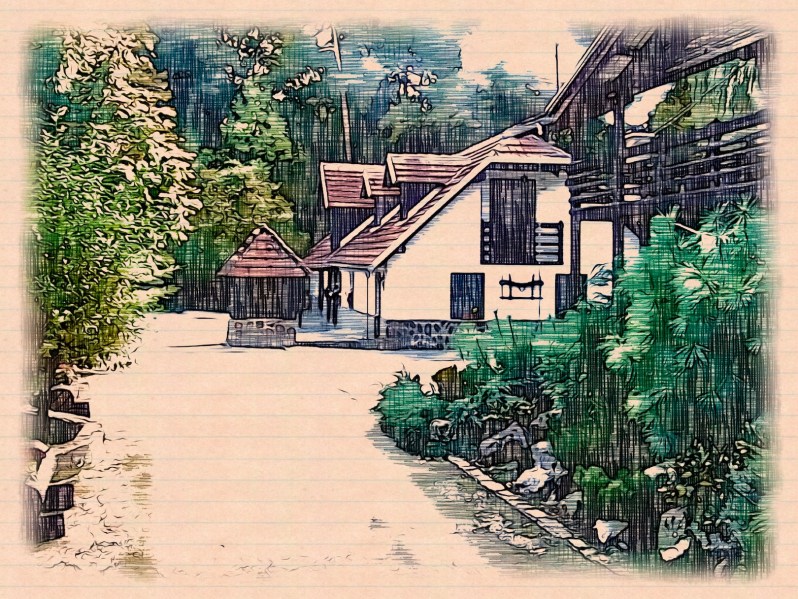
The old cottage sits at the point where civilization politely excuses itself and lets the forest take over. It stands as a vision in white against the deep green of the forest, its walls , weathered by countless seasons, gleaming in the morning light. A red-tiled roof rises like a cheerful mushroom cap above the morning mist. Dark wooden balustrades running along the upper terrace, and a foundation of rough-hewn stone that rises from the earth like it grew there naturally. Pine trees whisper their secrets around it, giving the cottage its name and protecting it from the world beyond. Everyone known it as “Whispering Pines Cottage” – the little house at the edge – though Madam Setsuna simply calls it home.
Dawn arrives here differently than in other places. First comes the chorus of birds, then the gentle sound of steps as Madam Setsuna makes her way, her steps practiced and precise. Behind her, Strela descends with equal grace, her white fur catching the first hints of sunrise through the diamond-faceted windows.
The kitchen is the heart of their morning ritual. It’s a room that belongs to neither East nor West, but somehow to both. Copper pots hang from rough wooden beams, sharing space with delicate Japanese tea cups. A traditional Slovenian ceramic stove occupies one corner, its warm bulk richly decorated with handmade ceramic tiles with bottom of clay bricks, which retain and radiate heat longer make it Strela’s favorite place to sleep. On the stovetop sits Madam Setsuna’s prized possession – an octagonal Bialetti Moka coffee maker, its staleness surface bearing the patina of countless morning rituals.
“Shall we begin our day, Strela?” Madam Setsuna asks, measuring coffee grounds with practiced precision. The iconic coffee maker, whose engineering design hasn’t changed since its 1933 patent, fits perfectly atop the ceramic stove. Strela settles onto her cushion by the glass door – a perfect observation post for both the kitchen and the garden beyond. Her glasses catch the morning light as she watches her human companion’s familiar coffee ritual.
The soft bubbling sound of brewing coffee mingles with morning birdsong. Madam Setsuna doesn’t hover over the coffee maker – she knows its voice well enough to recognize when the coffee is ready. Instead, she moves to tend her orchids in glasses, each glass carefully labeled in both Japanese and Slovenian. The familiar gurgling sound of the Moka maker signals that breakfast is nearly ready.
Outside their window, the gravel path winds between carefully tended beds of mixed botanicals. A covered well stands sentinel near the cottage entrance, its wooden roof matching the main house. Stone borders line the path, collecting morning dew like precious gems. The garden extends into a natural clearing, where Slovenian wildflowers bloom wherever they please between pines, firs, thujas and birches grow mixed with yucca.
Inside, as the last drops of coffee emerge with a characteristic puff of steam, Madam Setsuna pours the rich brew into a cup that once found at a flea market, its sleek two-layered steel glinting softly in the morning light. The triangular handle, worn smooth with time, felt like it carried whispers of stories from centuries past. It wasn’t just a cup; it was a survivor of ages, resilient and enduring, destined to outlast even her quiet morning rituals. A humble yet timeless companion, as if plucked from the pages of a tale where the mundane holds hidden magic.
The aroma fills the space between worn wooden cabinets and herb bundles, promising another day of possibilities.
Strela’s ears perk up at a sound from the forest – something too faint for human ears. Madam Setsuna glances at her companion over the rim of her coffee cup, their eyes meeting in silent communication. Perhaps this ordinary morning isn’t quite so ordinary after all.
 Stories of Madam Setsuna