The steam from the Bialetti coffee maker had barely dissipated. Madam Setsuna reached for her old notebook. It was leather-bound and worn smooth at the corners. It was her habit to review her notes while enjoying that first precious cup of coffee. Strela remained at her observation post by the glass door. She watched with particular interest this morning. Perhaps she sensed something different in the air.
As Madam Setsuna opened the notebook, three yellowed sheets of paper slipped free from between its pages. These sheets were creased and delicate with age. They performed a graceful dance to the floor. They scattered like autumn leaves, landing on the warm tiles near the ceramic stove. Strela perked her ears ahead. She tilted her head in that peculiar way, suggesting she found something curious about these ordinary-looking papers.
Adjusting her glasses with a practiced gesture, Madam Setsuna bent to retrieve them. The first sheet caught her eye immediately. It contained a systematic breakdown of Japanese katakana characters. The characters were arranged in neat columns. But there was something unusual about the notations. There were standard character pairs like ソ for ‘so’ and ゾ for ‘zo’. There were also タ for ‘ta’ and ダ for ‘da’. Additional markings were present. Subtle variations appeared that didn’t feature in any standard Japanese textbook.
The handwriting was precise but old-fashioned, the kind one might find in documents from the early Shōwa period. Blue ink had faded to a deep indigo, and the paper itself bore the subtle crosshatching pattern of pre-war Japanese manuscript paper. But it was the marginalia that made Madam Setsuna pause, her coffee cooling forgotten on the kitchen table.
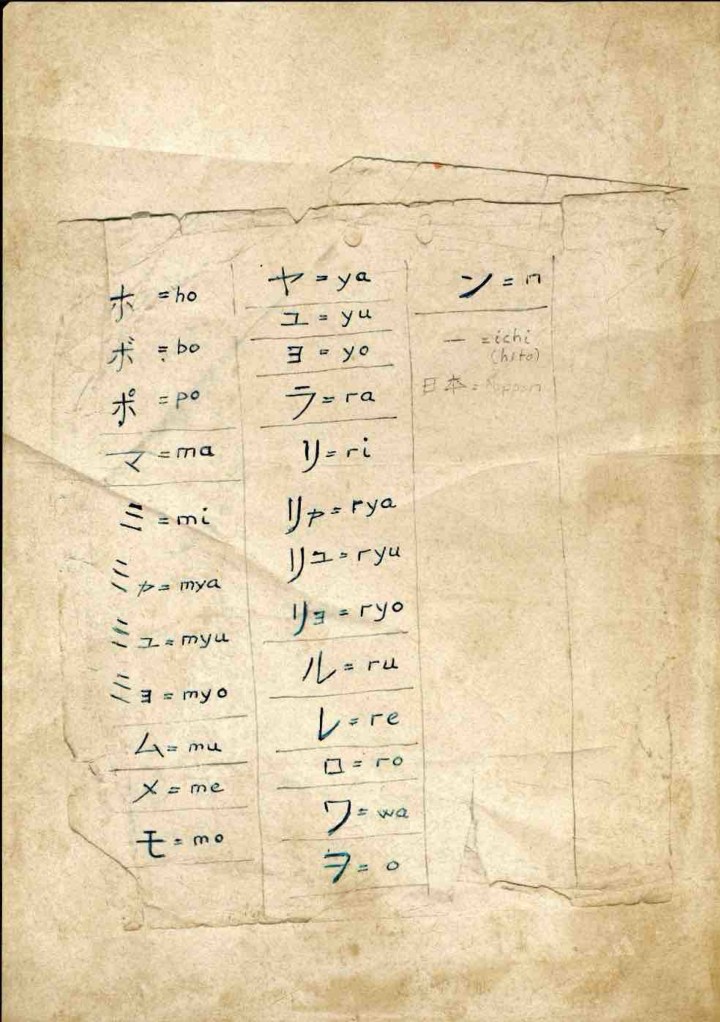
“Well, well,” she murmured, peering more closely at the sheets. “What do we have here, Strela?”
The Japanese Spitz rose from her cushion and padded over silently. Her own glasses caught the morning light. She studied the papers with an intensity that suggested these were more than mere language notes. The systematic arrangement of the characters was striking. The careful annotations added layers of meaning. Certain combinations were circled and connected with faint lines. Together, these elements hinted at something beyond simple language study.
Madam Setsuna spread the sheets carefully on the kitchen table, her steel cup pushed to one side. The morning sun streamed through the diamond-faceted windows. It cast an interesting pattern across the papers. Certain characters seemed highlighted, inexplicably, by the angle of the light.
“I believe,” Madam Setsuna said slowly, reaching for her magnifying glass, “we may need to postpone our garden work today.” She glanced at her companion with a slight smile. “These appear to be more than just language notes, don’t they?”
Strela’s tail wagged once, deliberately, as she settled into her thinking pose beside Madam Setsuna’s chair. Outside, a sudden breeze rustled through the pine trees, their whispers seeming somehow more urgent than usual. The morning had indeed taken an unexpected turn at Whispering Pines Cottage.
 Stories of Madam Setsuna